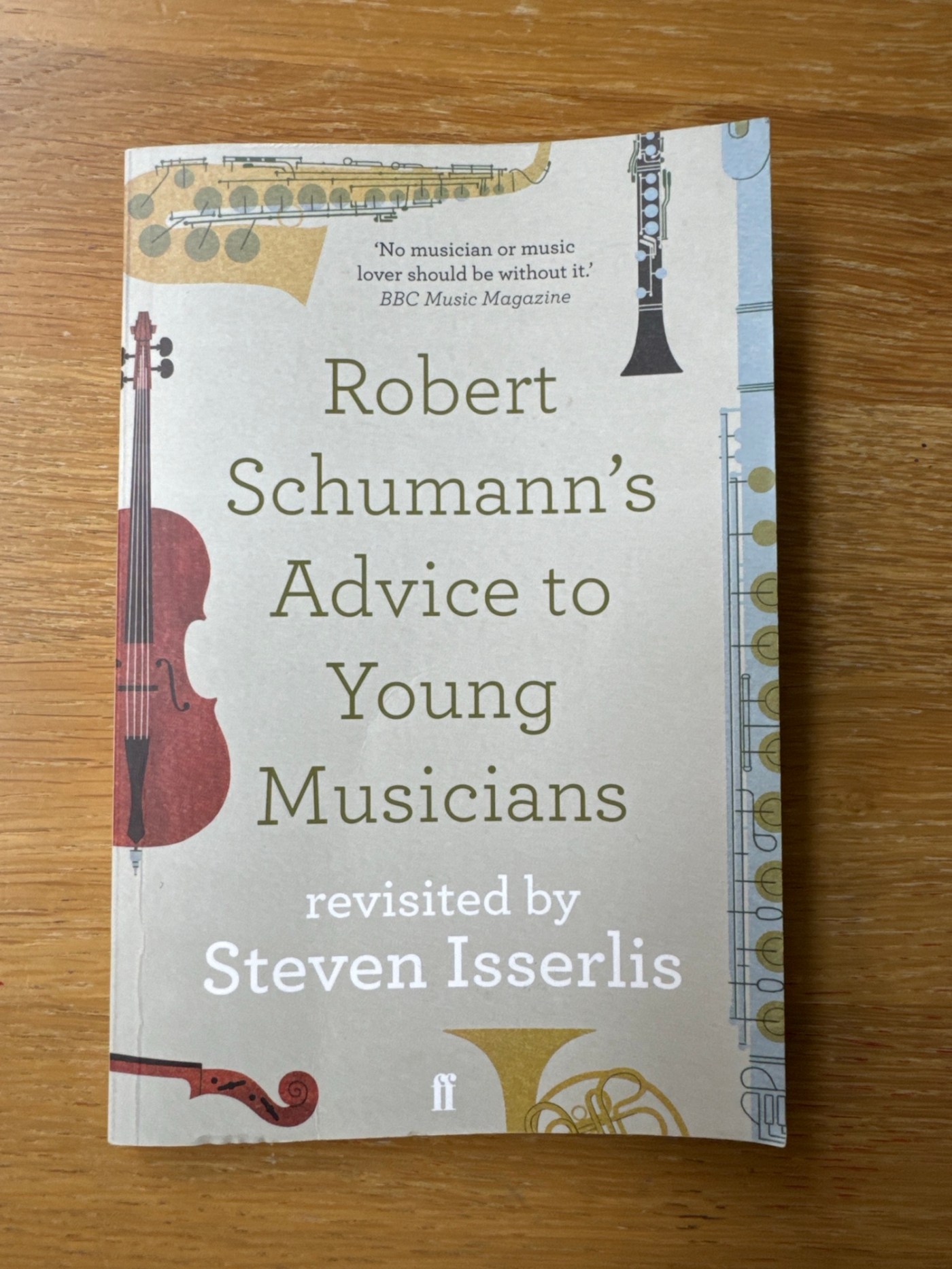
For this month’s Music Book Review I am looking at a book revisiting the advice that composer Robert Schumann gave to young musicians, but explained and added to by cellist and author Steven Isserlis. The title of this book is, unsurprisingly, Robert Schumann’s Advice to Young Musicians revisited by Steven Isserlis. This is not the first of Steven Isserlis’ books I have reviewed, and as an author I very much like his style of writing. If you are interested in his other books, maybe have a read of my last review of one of his books:
Music Book Review: Why Beethoven Threw The Stew by Steven Isserlis

Blurb from the back of the book:
Robert Schumann was so far ahead of his time: his music anticipated a multitude of trends that would spread in the 150 years after his death, and almost every major composer who followed him acknowledged his influence. He was also revolutionary in his attitude to young people; in 1848 he wrote his famous Advice to Young Musicians, a book that is still deeply relevant today.
In this volume, celebrated cellist Steven Isserlis has taken Schumann’s words of wisdom and set them in a modern context with his own extensive commentary. By turns practical, humorous and profound, this book is a must for aspiring musicians and music lovers of all ages.
What is this book about?
As the blurb above suggests, this book takes a book that had been written by composer Robert Schumann with his advice for young musicians and repeats it. But it doesn’t just give you this advice, author and cellist then updates that advice for a more modern audience.
For the main body of the book Isserlis has chosen some of the advice that Schumann includes in his own book. This is organised under subject areas of: On Being A Musician, Playing, Practising, and Composing. He then adds some more of his own advice to young musicians under those same headings and finally gives you the rest of the advice that appeared in Schumann’s book without Isserlis’ commentary in an Appendix if you choose to read it.
So what sort of advice does Schumann give us and our young musicians then? One of my favourites from the book is:
“You can learn quite a lot from singers, but do not believe all that they say!” In his updating and explanation of this advice Isserlis points out that “one can learn much about legato, about articulation, about breathing, about talking through one’s instrument, from them.”
“Never miss good opera.” Isserlis agrees that it is important to see and get to know ow opera if you can afford the tickets, and he says that that situation is getting better all the time, but it’s worth remembering before you read the book that it was published in 2016, before the cost of living crisis, and so it was getting more affordable to see lots and lots of things at the time. It is worth saying that if you hunt around there are still ways of seeing good shows without paying the price of, say a trip to The Royal Opera House or (to be local to where I am based) a big production at Birmingham Hippodrome, and maybe that is a subject for a separate blog post.
But why the need for Steven Isserlis to update this advice, why not just read Robert Schumann’s advice with no commentary? Well of course that is entirely a valid thing to do, and something that Isserlis talks about in his book. But Schumann was writing for an audience of his time and some of the advice seems outdated to readers today, especially young readers. He also seems to be writing, as is pointed out in the Introduction, for young composers and keyboard players- and particularly advanced ones at that, and Isserlis believes that the advice is actually relevant to all young musicians and even adults reading this book too, and I have to say that I would agree with him.
This is the second of Steven Isserlis’ books I have read and reviewed for this blog, the first being the book Why Beethoven Threw The Stew, about the lives of some of Isserlis’ favourite composers (link below to my review of this book). This book too has the same, slightly irreverent tone that Isserlis uses in his book. He writes very well for younger audiences. His books are fun, they make music history a much more interesting and engaging topic because he does not take it too seriously, while showing how much he loves the topic he is writing about at the same time.
Music Book Review: Why Beethoven Threw The Stew by Steven Isserlis
Who is this book for?
This is a non-fiction book for children and even their adults interested in music. I would say that this is not a book for children who only have a passing interest in music, but is more for children whose interest is growing deeper. And in saying that I am not saying that the book is only for children who have decided to study music for public exams- GCSEs or A-levels for example; but rather for children who have been learning to play an instrument or have been singing in a choir for a while already and want to continue.
I have got my son, who is 10 at the time of writing this review, to read the book. He said he enjoyed it and that he thought the advice in the book was interesting and useful.
I would probably recommend s the boom for children aged 10 or 11 and over. I wouldn’t necessarily suggest an upper age range for the book. I must admit that I don’t think I would buy it for a 17 or 18 year old, but as an adult reading the book I got quite a lot out of it too.
This book is a short read at 103 pages.
Where to buy the book
At the time of writing this review, the book was available on Amazon priced at £8.83, but do bear in mind that prices on Amazon can fluctuate depending on demand.
Would I recommend this book?
In short, yes I would. The advice is good. I like Isserlis’ writing style and think it is very well suited to children. I think he makes what can often be thought of as a very dry subject much more interesting and fun.
This book could be used as a springboard for your young musician to think about young people’s experience of learning music and the advice they were given if they had live during The Romantic Period in music history when Schumann was writing his original book; and to think about how their own experience as a young musician differs. And much of the advice he gives is as relevant for young musicians today as it was in his own time. So yes, I would definitely recommend this book.
If you have enjoyed reading my blog post, thank you. I am always looking for ideas for the blog, so would love to hear from you with suggestions for topics you would like me to cover in the future. Also, if you would be interested in supporting me to keep this blog running, buying the books to review here, and supplies to make the DIY instruments, for example, I would be absolutely delighted if you would consider buying me a coffee using the following link: Buy Me A Coffee Thank you!!
 getkidsintomusic.com