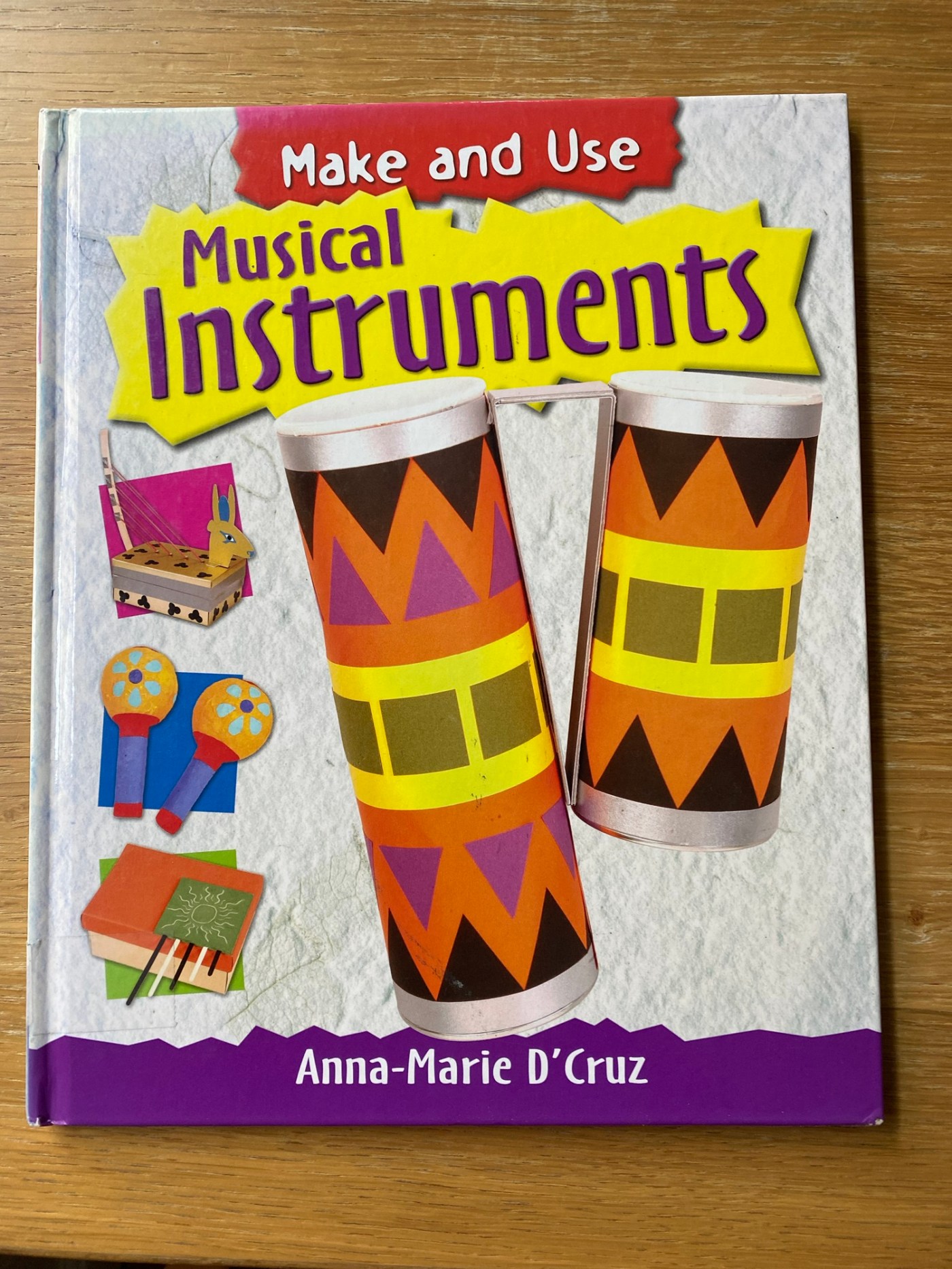
A couple of months ago, I wrote a review of a book about Classical Composer Mozart from the Little People, Big Dreams series of books. I mentioned in that review that I had got that book from our local library, and extolled the virtues of the library. If you have read this blog before you will know that I currently live in Birmingham in the UK. And you will know from the news that Birmingham’s Council is in quite a bad state in terms of its finances. As well as massively cutting the funding to lots of different departments, including making a 100% cut to its funding for cultural institutions and organisations, 25 out of the city’s 36 libraries are due to close. It has never been more important to go into and support your local library. So when I took my son into our local library to choose some more books recently, I also had a look at the books about music in the library. This fantastic book, Make and Use Musical Instruments by Anna-Marie D’Cruz was on the shelves, and I absolutely couldn’t resist picking it up.
Get crafty! Follow the step-by-step instructions to make your own musical instruments. Find out more about each project by reading the panels that explain the science, history, culture or craft behind each project. With straight-forward instructions and fabulous photographs to show you what to do, making different instruments could not be easier.
In this book, make and use your own:
Castanets – Bongo drums – Jazz washboard – flute – African thumb piano – Hand drum – Maracas – Egyptian harp
Blurb from the back of the book Make and Use Musical Instruments by Anna-Marie D’Cruz
We love making musical instruments in our house. And I have to say as a mum, these are such fantastic projects to do in the holidays. We live in the UK and so it is absolutely guaranteed that there will be at least one rainy day during the school holidays. Probably at least one rainy week if we’re honest. Making a musical instrument is a great activity for the children to do with you. You can get hold of kits where most of what you are doing is just decorating the instruments before putting them together (see the 2 examples below of kits I have already tried with my children), or you can gather together stuff that you will probably already have in your house, like old food containers and rubber bands and spend time making a musical instrument. Kids love craft activities, and with some of these musical instruments they can do quite a lot of the work involved independently. Depending on the age of your child, and how you feel they will get on with this activity. Then at the end of doing these craft activities together they get a musical instrument to play. And crucially, the instrument is generally not a particularly loud one so will not drive you crazy when they play with it.
So, of course, a book with lots of ideas for musical instruments is right up our street! There are a couple of instruments in here that we have already made together, but there are also several that I would like to have a go at making with the children. I am writing this blog post at the end of the Easter holidays- what timing, eh?! So hopefully in the next couple of weekends, or at least in the next holidays, we will have a go at making one or more of the instruments in the book, I will share the results of our musical instrument crafting with you when we give it a go.
On to the book itself. It starts with a couple of pages telling your young reader about different types of musical instruments, and about how music plays a very important role in many different cultures across the world. It also reassures you and your children that you do not need to make your instrument look exactly how they look in the book, all you need to do is to have fun making and playing your own musical instruments. Something I say to my children all the time is that with the arts, yes when studying them you learn some basic rules about how music (or art) is put together but in terms of making your own music or your own art, especially when you are doing it for fun at home, there is no right or wrong answer. The important part about it is having a go, experimenting and enjoying yourself in the process.
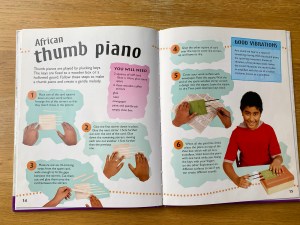
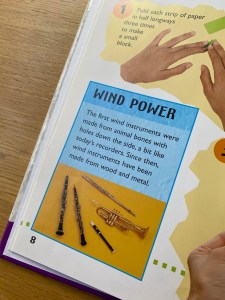
Next, we go on to the instruments themselves. For each musical instrument, D’Cruz gives you step-by-step instructions on how to make these instruments and many of these instructions, where they are needed, have pictures to show you exactly what to do. The instructions are clear and concise, written in easy to understand language. Both of my children, I think, would be able to read and understand the instructions by themselves. My 6 year old may need a little help understanding a couple of the instructions, but only a little. All of the instruments all made with items that you may find you already have in the house, like shoe boxes, coffee stirrers or lollipop sticks, cardboard, elastic bands. For each instrument you will find a pink box which gives you a sort of shopping, or scavenging list, of what you will need in order to make that musical instrument. The written instructions are all given in a teal coloured frame; and for each of the instruments, in a blue coloured box D’Cruz tells you something more about the instrument. That may be telling you a little about the science involved in how the instrument makes sound, historical information about the sort of ensemble (band if you like) that instrument would be played in, or some historical context to where that instrument originated from. All of the information, I feel, is pitched for younger readers.
Who is the book for?
As I mentioned above, I think I could leave my 6 year old with the book and, while she may have some questions about its contents, I think she would be able to read and understand it independently. My son, at nearly 10 years old, I think would also quite enjoy this book. The caveat for this is that it is a very practical book so he would enjoy making the instruments. If this were a general non-fiction book for him to just read without the practical aspect to it, it would be too young for him. It would not be quite complex enough for him I don’t think.
So who do I think this book is for? As always, you know your children much better than I do, what their levels of concentration, reading level and interest level would be. Given the very practical nature of this book, my recommendation would be much broader than it normally would be.
So, for children reading this book as an exercise purely for reading practice, I would recommend the book for probably ages 6-maybe 8. The level of information is about right for those ages, there is not too much information for the children to lose their concentration, there are plenty of pictures, and the information presented is organised into different coloured boxes or frames that help you to understand what you are reading more easily. For children (and their parents) reading this book as a springboard for making their own musical instruments, well quite frankly I want to have a go at some of them as much as I know my children will want to. As you go through the book the instruments become harder and more complicated to make. I would have used this book with my children from when they were probably 3 or 4 years old making the castanets at the start of the book, but I absolutely wouldn’t attempt the Egyptian harp (the last instrument in the book) with them at that age. I may well give that instrument a go with the children now – my daughter is nearly 7 and my son nearly 10 at the time of writing – I would say, though, that both of my children have made a lot of musical instruments with me over the years, and they are both do a lot of music and arts and crafts activities at home.
So, all of that is a long-winded way of saying that if you are reading this book to give you some ideas of activities you would do with your children, I think the activities would appeal to children aged from 3 or 4, to 10 or 11, maybe even older.
As mentioned above, I got this book out of my local library – if you are inspired to read this book from this post I cannot guarantee that you will find it in your local library this month, whereas when I review books I have purchased then I know they will be in stock in at least some book shops right now. However, if you go into the library looking for this book and it is not there, chances are you will find at least 6 other books that look fun to read. And the library we use offers word-based treasure hunts where children solve the treasure hunt in return for a sticker, and that treasure hunt has been different every time we go in. It offers activities like story time, some offer music classes for babies and toddlers, or rhyme time activities. It offers events and activities for school-age children after school and in the holiday. And most importantly, the books are free to look at in the library and to borrow. Books about music can be on the expensive side, so if you have a rather voracious reader in your house, like I have in mine, the library is absolutely essential for keeping plenty of books in your house for them to read.
The downside to library books is that you do have to give the books back, though, and there have been several of the books I have reviewed here that one or other of my children have wanted us to read over and over again and would have been very sad to hand them back to the library. So if you would prefer to purchase this book, Make and Use Musical Instruments by Anna-Marie D’Cruz then at the time of writing this book can be purchased from Amazon (or maybe your local bookshop) priced at £8.85 second hand, but be aware that prices on Amazon do go up and down depending on demand for the book.
If you have enjoyed reading my blog post, thank you. I am always looking for ideas for the blog, so would love to hear from you with suggestions for topics you would like me to cover in the future. Also, if you would be interested in supporting me to keep this blog running, buying the books to review here, and supplies to make the DIY instruments, for example, I would be absolutely delighted if you would consider buying me a coffee using the following link: Buy Me A Coffee Thank you!!
 getkidsintomusic.com