In my series of posts about different musical instruments, I have, over time, managed to cover most of the most common instruments that feature in Western music – those instruments that your children are most likely to be learning to play, or to come across in some way during their time in education at least. So rather than either go back over those instruments I have already written about, or write about less common instruments (which is something I may well do in future years), I thought I would now use my Facts About… series of posts to talk about the most common ensembles that your children will listen to, see perform, or maybe play or sing in. Again, my focus is on ensembles that feature in Western traditions, and it may well be that in the future I look at musical instruments and ensembles from other musical traditions, but for now I will stick with what I know.

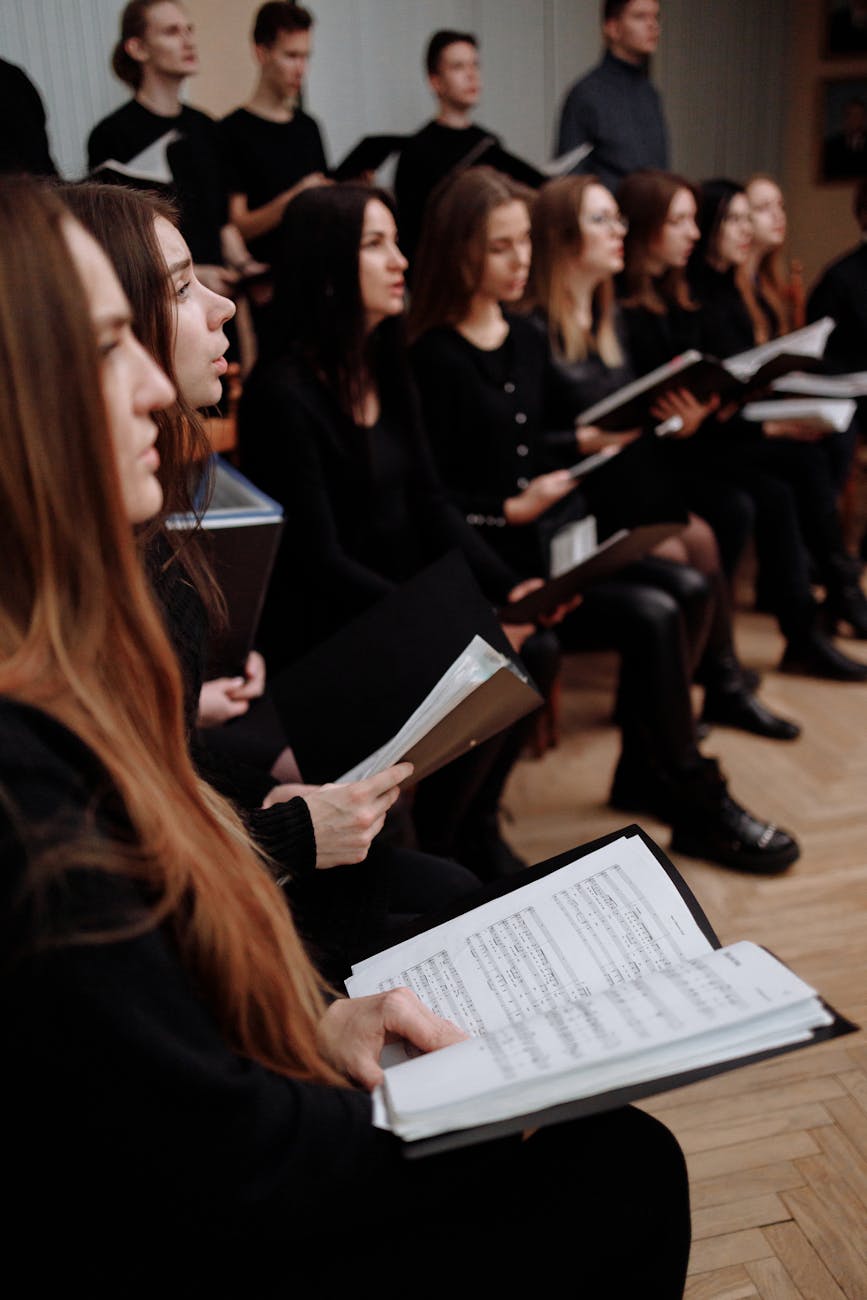
What is the choir, and who performs in it?
- A choir is defined in the dictionary as “an organised group of singers, especially one that takes part in church services, or performs in public.”
- While many musical ensembles are made up from a specific number of musicians – for example a string quartet will always have 4 people playing in it – a choir can be pretty much any size. In Classical Music a smaller group of singers is called a Chamber Choir, as it would be a choir that could fit into a smaller room, or Chamber, rather than needing a larger room to fit the performers into.
- A choir is made up of a group of singers, and those singers can either all sing the same line of music – most common with children’s choirs when they are just starting out – or different lines of music at the same time – melody and harmony lines.
- Children’s choirs will sing simpler songs. As I mentioned above, they will often have all of the children singing the melody, or tune, to a song all together. As children get older, and their musical ability progresses, they may all sing the same melody in a round (see my blog post about singing songs in rounds for more information about this fun way to sing and start learning to sing in harmony), or one part may sing the melody and another start to add in some harmony.
- As children progress even further into their musical studies, and have more experience with singing in a choir, and on into adulthood, choirs start to use different types of voice. The most common mix of voices in a choir would be Soprano, Alto, Tenor and Bass. This is often shortened to SATB. For a church choir you may also find Trebles singing.
- Some choirs, of course, do not have all voices within their ranks. You will find various different types of choir with only one or two types of voice. Male Voice Choirs, Women Only Choirs, Barber Shop Choirs.
- I have mentioned that the most common voice types in a choir are Soprano, Alto, Tenor, Bass and also Treble, but what do those terms actually mean?:
- Treble:- a high pitched voice, generally referring to a child’s voice, and commonly young boys’ voices
- Soprano:- the highest pitched female voice, very regularly carries the tune.
- Alto:- the lower pitched female voice, usually provides harmony to the tune.
- Tenor:- the highest pitched male voice, usually another harmony line for the music.
- Bass:- the lowest pitched male voice, and will usually provide, yes you guessed it, the bass line to a piece of music.
- There are other voice types which may or may not appear in a choir, and some voice types that will more often appear in opera than in choral music. Why have I separated these out? Well opera certainly does feature a chorus and these choruses are very similar, if not identical to a Choir as I am writing about today. The main difference between what I would describe a choral music, and what I would describe as their Chorus in an opera, is the dramatic nature of the opera. A choir will not also be acting out their songs. There may be actions that go along with the words sung, but those singers will not also be acting a role whilst singing unless they are part of an opera chorus. As with anything in music, there are exceptions to this.
- Some choirs only sing a specific type of music. Church Choirs, Show Choirs, Gospel Choirs for example.
- Some choirs perform with other musicians – with a pianist accompanying them, or them accompanying an orchestra, one single orchestral instrument performing with them (for example the Ceremony of Carols by Benjamin Britten that is performed by choir and harp), and some sing without any accompaniment. These latter choirs are known as a cappella choirs.
- So, if I am talking about a traditional SATB choir (remember, that’s Soprano, Alto, Tenor, Bass), then the singers will have a place to stand in their choir. Many conductors may play around with where their singers stand depending on the music they are singing, and the people within their choir to make sure the music can be properly heard by the audience.
- Traditionally, people singing a particular voice will all stand together. So Sopranos will stand with other Sopranos, Tenors with other Tenors etc.
- In many choirs the singers will be organised in the same way. Female and younger voices will stand towards the front of the choir with the higher voices, Sopranos and Trebles on the right of the conductor (as the conductor is facing them). The Altos will be on the left of the conductor. The higher male voices will be stood behind the Sopranos and Basses behind the Altos.
Singing songs in rounds – a fun way to introduce harmony to your children
History of the choir
- If you take the definition of choir as just any grouping of people singing, then I think you would not be going wrong to say that choirs have existed as long as singing has existed. Singing is obviously one of mankind’s earliest forms of musical expression, if not the earliest, as you don’t need any kind of instrument for it, just your voice. The development of the choir and choral music has a history as long as the history of humankind, and ion a short blog post such as this, I can only hope to give you a little flavour of that rich and diverse history.
- I should also, probably, say here that the incredibly brief history In give here concentrates solely on the choir as you would find in Western Classical traditions. I do not include the history of the gospel choir, for example, which has its own rich history and deserves a post all of its own.
- Greek and Roman civilisations developed the traditions of choral singing that tribal communities engaged in as part of a community rituals, to use choirs to accompany religious or political ceremonies, or for entertainment. Indeed the first choral competition took place in Greece as early as the 5th Century.
- In the Christian church choral singing as part of a religious ceremony has been used since at least the 4th Century.
- Moving on into the Medieval Period, composers started writing polyphonic music (music with more than one line, say melody and harmony, working together), and so choral music started to become more complex, rather than mostly groups of people singing the same melody line in unison. The church started to appoint people to fulfil different roles, including directing and running the church’s choir.
- Around this time composers like Leonin in France, and Hildegard von Bingen in Germany were writing choral music which started to explore polyphony more and more. Hildegard von Bingen was born in 1098 and died in 1179. She was a Benedictine abbess, a writer, philosopher and medical writer and practitioner. She was also one of the leading composers, especially of choral music, of the time.
- Moving on into the Renaissance period in Music History (roughly 1450-1650) and the choir was still largely associated with religious settings. Outside of these religious settings you would probably find groupings of folk musicians singing together, but far less is known about this less formal tradition. The word Renaissance comes from the French language and means re-birth. There was an explosion, or re-birth of interest in, participation in the arts of all kinds in this period.
- Many composers in the Renaissance period wrote music glorifying God, or as part of a service of worship. The choral music written in this period is no different, and much of the most beautiful choral music that is still listened to today will date from this period.
- For a long period of time the only opportunities for a composer to be paid for the work they produced was to write music for either the church or a Court, so for the Royal Family of the country they lived in. Or the Aristocracy there. There is a wealth of choral music written to celebrate special occasions, like Coronations.
- Most secular (meaning non-religious) vocal music before the development of the Opera, was written for solo vocalists. It was probably the development of the Opera where stories set to music and that were not religious in nature could be told on stage. The chorus in the opera paved the way for composers being more free to write secular music. Sometimes without the need for the patronage of the church or the Court.
- The Choir itself has probably not changed too much over time in terms of combining male and female voices. It is the complexity of the music that composers write for the choir, or the huge variety of differing musical styles and genres (or types) that has developed over time.
- As the music written for choirs to sing has become more complicated, choirs have grown in size – choral music can feature any combination of parts for their vocalists. While often sopranos will all sing the same line in their music, the soprano voices may well split into two or three separate lines of music, and the same with all the other voices in the choir. This can give choral music a very rich, full sound.
- Today, there are so many different types of choir, and so much choral music to be sung. I think there is pretty much a choir for everyone.

Choir World Records
- The Guinness World Record for the world’s largest choir was obtained in Chennai, India on 30n January 2011 when an absolutely enormous 121,440 people sang together at an event organised by The Art of Living. This huge group managed to sing in unison (altogether) for 5 minutes. That might not sound a lot, but keeping that volume of people singing the same line of music for that long is absolutely no mean feat!
- In April 2013, the St. John’s House Care Home in York obtained the Guinness World Record for having the choir with the oldest members. At the time they had an in-house choir with 13 members whose average age was 91.
- On the subject of largest choirs, the Guinness World Record for the largest gospel choir is currently held by the Iglesia Ni Cristo (Church of Christ), based in Ciudad de Victoria in the Philippines. On 22 May 2016, this gospel choir performed with 21,262 people.
- The Guiness World Record for the largest musical act to release an album was obtained on 23 October 2009 by the Rock Choir in London, UK. This choir’s album featured 4,386 singers, who ranged in ages between 6 and 80.
Sources, especially for historical information
If you have enjoyed reading my blog post, thank you. I am always looking for ideas for the blog, so would love to hear from you with suggestions for topics you would like me to cover in the future. Also, if you would be interested in supporting me to keep this blog running, buying the books to review here, and supplies to make the DIY instruments, for example, I would be absolutely delighted if you would consider buying me a coffee using the following link: Buy Me A Coffee Thank you!!
 getkidsintomusic.com