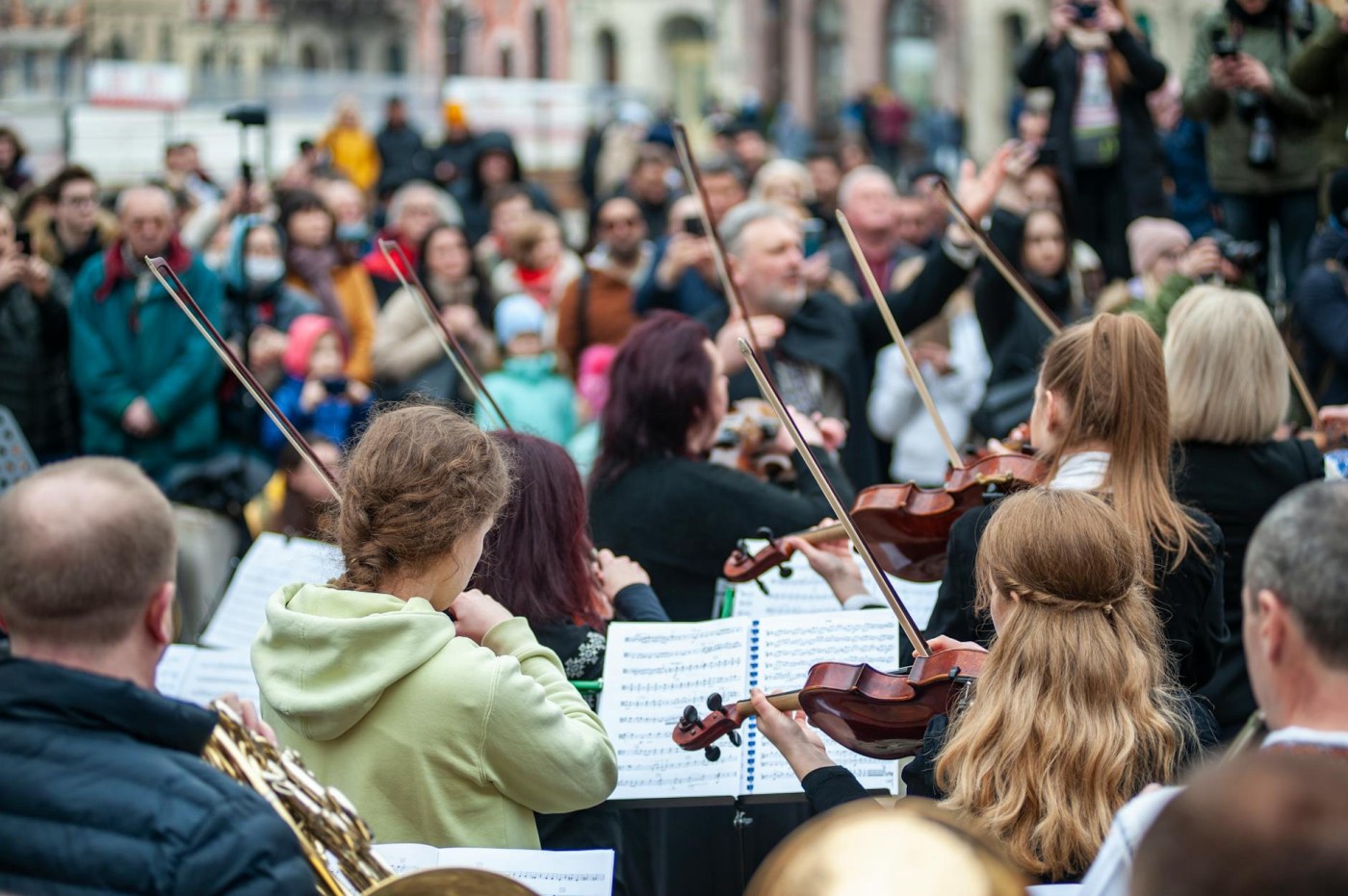
In my series of posts about different musical instruments, I have, over time, managed to cover most of the most common instruments that feature in Western music – those instruments that your children are most likely to be learning to play, or to come across in some way during their time in education at least. So rather than either go back over those instruments I have already written about, or write about less common instruments (which is something I may well do in future years), I thought I would n ow use my Facts About… series of posts to talk about the most common ensembles that your children will listen to, see perform, or maybe play in if they are learning to play a musical instrument. Again, my focus is on ensembles that feature in Western traditions, and it may well be that in the future I look at ensembles from other musical traditions, but for now I will stick with what I know.
What is the Orchestra, and which instruments feature in it?
- An orchestra is defined in the dictionary as “a group of instrumentalists, especially one combining string, woodwind, brass and percussion sections and playing classical music.”
- An orchestra is a fairly large ensemble intended for performance in a large room like a Concert Hall, rather than in someone’s house, or a small performance room (or chamber, if you like – I will write about chamber ensembles as this series progresses). This larger room is needed just to fit the number of musicians who will be playing together in, let alone to accommodate an audience as well.
- The orchestra features musicians from almost every family of musical instruments, except for the keyboard and electronic families (usually, there are exceptions to every rule.)
- To be specific, musical instruments that most commonly feature in the orchestra are:
- String family:- violin, voila, cello and double bass.
- Woodwind family:- flute, oboe, clarinet, bassoon.
- Brass family:- trumpet, trombone, french horn, tuba.
- Percussion family:- drums including snare drum, bass drum and timpani, xylophone, cymbals, triangle
- Other instruments will join the orchestra depending on what instruments a composer has written for.
- The musicians in an orchestra will sit together, so the violin players will sit together, the cellists, the flautists etc. And the families will sit together, with the strings sat arranged in a semi-circle nearest the conductor, the woodwind just behind the middle section of strings facing the conductor. Brass players sit behind and to the sides of the woodwinds, and percussion tend to stand behind the rest of the performers – they stand because percussion players will play a number of different percussion instruments during a performance, not just one – with the exception of the timpanist who usually stays put during a piece.
- Within each section, you will have different parts – usually labelled as the first and second (more if required), so first violins, first clarinet, second bassoon for example. A composer will have arranged their music so that they can take advantage of each section having a different line to play – the first violins will play one line of music, while the seconds will play a separate line. In that way a composer can add colour and texture to their music. Of course they may want all violins, or all strings, or any combination of instruments to play together – the only limits are what each instrument is physically capable of doing, and the composer’s imagination.
- It is generally the most experienced and skilled musicians who sit in the first positions within a section as their music is often harder to play, or more technically demanding, than the seconds. If you are watching a professional orchestra perform, then all of the musicians there will be fantastic and gifted players, of course. But if you are a cellist starting out in your local Youth Orchestra, or School Orchestra, you will probably find that you start off playing second cello, and move up into the first cello position when you have more experience playing, and achieve a higher standard of playing and move up the grades.
- The definition given at the start of this post of the orchestra “playing classical music” is correct if you are thinking of classical music as being pretty much everything that is not performed by pop musicians or jazz bands (to be perhaps overly simplistic).
- In reality, orchestras play hugely varied repertoires, from music written in almost every period in music history, and yes that would, mostly be from the Classical period (roughly starting in 1750) onwards. They play on movie soundtracks, they play on video game soundtracks, for musical theatre, even orchestral versions of many pop songs.
History of the Orchestra
- Musicians have been playing together in various groupings (or ensembles) for many hundreds or even thousands of years, but the orchestra as we know it is a relatively new (when compared to the whole of music history) concept.
- Actually, before the word “Orchestra” was applied to a group of musicians playing together, the Ancient Greeks were using this word to refer to a large semicircular performance space used for dancing or dramatic performance. The chorus in Greek theatre would stand in the orchestra to speak, sing and dance.
- The Romans used the word Orchestra for similar purposes, but for the Romans the orchestra was a place where stage effects would be located, and as the orchestra would often be flooded when sea battles featured in a play, the orchestra was moved to a pit area, or area in front of the stage which would be lower than the stage itself – we still use orchestra pits in opera houses and theatres today.
- Composers in the 1500s would write music for groups of musicians to perform together. But they would write music that could be played on virtually any instrument, perhaps even sung, and these performers would play “in consort” with each other.
- It was composer Claudio Monteverdi, in the early 17th Century who started to write music to be played by specific instruments. He knew what the sound was that he wanted to create to accompany his opera Orfeo, and so he wrote music that was specifically intended for particular instruments to play.
- The make up of the orchestra changed over time. In Monteverdi’s day, he wrote music to be played by the ancestors of the string family – the viol family, and the string instruments we know and play today started to take over from these earlier instruments.
- Woodwind instruments, and later brass instruments would join the orchestra over the course of the 17th and 18th Centuries, and in the late 1800s composers started to write music that they wanted to have a large, lush sound. So more and more musicians were needed to make that large, lush, rich sound that these Romantic composers wanted to create.
- Before the Romantic period the first violinist, or concertmaster, would conduct the orchestra from their chair, but as the size of the orchestra grew, and more musicians tried to follow the first violinist, this became harder and harder to do from a seated position. Many of the musicians simply couldn’t see to follow the concertmaster. It was Romantic period composer-conductors like Felix Mendelssohn who started to stand in the centre of the orchestra, on a raised platform to conduct the orchestra so that all musicians in the ensemble could see and follow them, and the orchestra could play in time with each other.
- The basic size, seating plan, and instrumentation of the orchestra that you will see if you go to see a concert tomorrow, is largely unchanged since the Romantic period. That is not to say that composers haven’t experimented with the orchestra in that time. Composers may add unusual instruments to a piece of music. Composers may want a much larger woodwind or brass section than normal, or a much larger string section. They may want to exclude some instruments you would usually expect to see. They may double the size of the orchestra. They may use some electronic instruments, or some play between pre-recorded music and live music. The limits on what a composer can do with an orchestra are, as I may have said above, the physical capability of the instruments involved, and the composer’s imagination. Otherwise, pretty much anything goes.
Orchestra World Records
- The Guinness World Record for the world’s largest orchestra was obtained in November 2021 by El Sistema National de Orquestas y Coros Juveniles e Infantiles de Venezuela in Caracas, Venezuela when 8,573 musicians played together in an orchestra – that is one enormous ensemble!
- The Guinness World Record for the world’s oldest existing symphony orchestra is held by the Gewandhaus Orchestra of Leipzig in Germany which was established in 1743. It was originally called the Grosses Concert, then the Musikbende Gesellschaft before adopting its current name in 1781.
- The Guinness World Record for the largest number of concerts given by an orchestra is currently held by the New York Philharmonic. At the date that the orchestra was assessed for this world record, 18 December 2004, they had performed 14,000 concerts, and they have probably added a few more in the last 20 years.
- My favourite orchestra based World Record is the one gained in October 2019 by The Vegetable Orchestra (Austria), who are the current holders of the Guinness World Record for the most concerts by a Vegetable Orchestra!
 getkidsintomusic.com