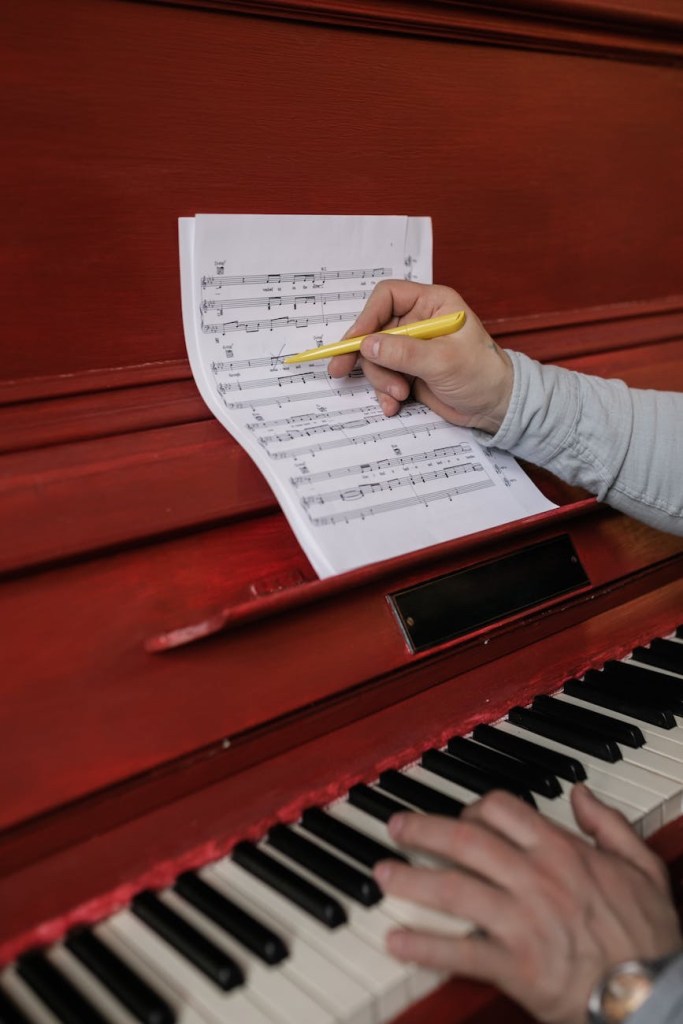
Composer of the Month
Factfile
Date of birth: 21 September 1874.
Place of birth: Cheltenham, Gloucestershire, UK.
Parents names: Adolph von Holst (professional musician) and Clara Cox.
Siblings: Gustav Holst had one brother, Emil, who became known as Ernest Cossart. He also had two half brothers, Matthias and Evelyn from his father’s second marriage after his mother’s death.
Age started playing a musical instrument: As soon as his hands could reach the keyboard – so very young then!
Age started composing: Around 12, while a student at Cheltenham Grammar School.
Height: Unknown.
Married: (Emily) Isobel Harrison.
Children: 1 daughter, Imogen.
Date of death: 25 May 1934.
Early Life:
Gustav Holst was born into family of professional musicians who went back several generations, including a great-grandfather who had been a composer and harp teacher to the Imperial Russian Court. So he was almost bound to be a musician.
Sadly Holst’s mother died in 1882, when Gustav Holst was just 8 years old and at that point his aunt, Nina, took over raising Gustav and his brother. His father later remarried and had two more children. While Holst’s family grew, neither his father nor mother spent a lot of time with Gustav and Emil as they were both busy doing other things. Several of Holst’s early compositions were dedicated to his aunt Nina in appreciation of the care and attention she gave to Holst.
Holst learned to play piano and violin, starting to play the piano from as soon as his hands could reach the keyboard. He loved playing the piano but hated the violin, and at age 12 her instead took up the trombone in a bid to help improve his asthma. Holst started composing around the same time in 1886. His Father wanted him to become a professional pianist, but Holst had a number of health issues, including weak eyesight (though he did not have his eyes tested and wasn’t given glasses to help), asthma, and a condition called neuritis, or inflammation of the nervous system, which made playing the piano very difficult for him.
Holst applied for a scholarship at the Royal College of Music in 1893, but lost out that year to composer Samuel Coleridge-Taylor. He still attended the college as a non-scholarship student, but money was very tight for him at the time. Partly due to his finances, and partly for because he wanted to, Holst became a vegetarian and teetotaller. He supported himself by working as a professional trombonist in London Theatres, and at seaside resorts during the summer months. He did eventually obtain a scholarship at the Royal College of Music.
For a while after leaving the Royal College of Music Holst supported his composition by continuing to work as a musician, but he abandoned this career in the early 1900s in order to concentrate on composing. Unable to make enough money to live on from composing alone, Holst began a career as a music teacher, teaching in various colleges and schools. He is probably best known for teaching at St Paul’s Girls School in Hammersmith, London, and Morley College, London. This left Holst having just evenings, weekends and the summer holidays for composition, but Holst was still able to write a lot of very beautiful and famous works. Less than composers like Mozart and Beethoven who were able to compose full time, maybe. But he was still quite a prolific composer, considering his other commitments. Holst wrote a number of compositions for his students, including the St Paul’s Suite for strings.
Holst’s work as a composer became more and more in demand in the 1920s with orchestras competing to be the first to play his new works. As a result Holst started to become well known, something he didn’t really like at all – he refused to accept awards or honours offered to him, or to do interviews. It all became too much for him, and he returned to his much quieter life composing and teaching only at St Paul’s Girls School in the mid 1920s. He took on various commissions and jobs, including a 6-month lectureship at Harvard University in the USA, where he spent some time with his brother, Emil who had a successful acting career which had taken him to Broadway.
As his health got worse, Holst took on less and less work, though his association with St Paul’s Girls School continued. Holst died of heart failure after an operation for a stomach ulcer on 25 May 1934. He was 59 years old. His most famous work is undoubtedly The Planets Suite, a piece of music that I will write more about next week.
If you have enjoyed reading my blog post, thank you. I am always looking for ideas for the blog, so would love to hear from you with suggestions for topics you would like me to cover in the future. Also, if you would be interested in supporting me to keep this blog running, buying the books to review here, and supplies to make the DIY instruments, for example, I would be absolutely delighted if you would consider buying me a coffee using the following link: Buy Me A Coffee Thank you!!
 getkidsintomusic.com
Leave a comment